


Novelty – 2026-06-05
Habitat 7 - an office block that sets new rules
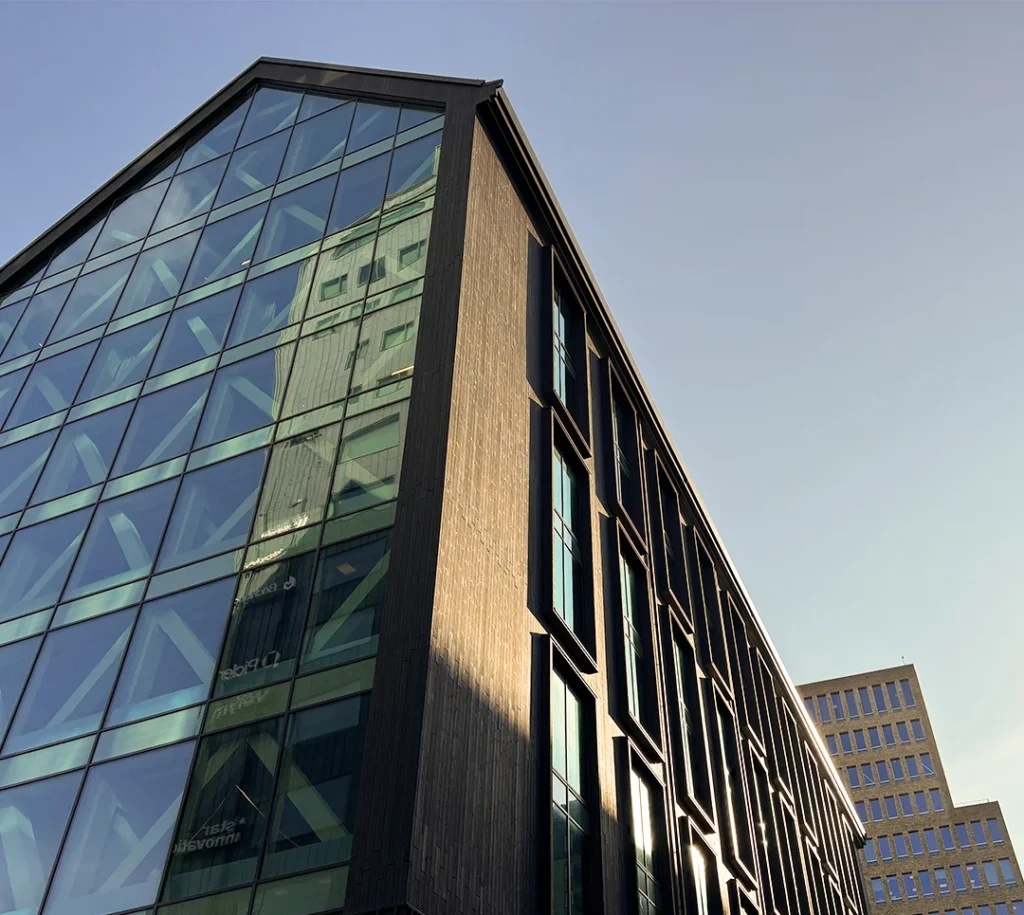
In Gothenburg, Masthuggskajen is currently being gradually transformed from industrial land into a vibrant urban fabric, with a project emerging that has captured the industry’s attention. Not for its scale or its architectural gestures, but for what it represents: a concrete and measurable answer to one of the construction industry’s most pressing questions – how do we design buildings that take full responsibility for their climate impact, from the first drawing to the last day of operation?
Habitat 7, NCC’s recently completed office building on Masthuggskajen, is Sweden’s first Zero CO2-certified office building of its kind and has quickly established itself as a benchmark in architecture, urban planning and sustainable construction. Eight storeys of timber, understated in appearance yet bold in ambition.
The ZeroCO2 framework, administered by the Sweden Green Building Council, is one of the most comprehensive certification schemes on the market. It covers not only the direct emissions from the construction process but also tracks the property throughout its entire life cycle, requiring that all remaining climate impact be offset to achieve actual net zero. It is a standard that leaves little room for compromise and places high demands on all players in the supply chain.
A natural part of a long-term commitment
For us at SI Sustainable Intelligence, Habitat 7 was not a leap into the unknown, but rather a logical continuation of our long-standing collaboration with NCC in Gothenburg. From Kineum in Gårda to Oceana at Liseberg, SI has consistently delivered advanced control solutions for projects where the demands for precision and energy performance are high. Habitat 7 represented the next level in that commitment.
”It goes without saying that we want to be part of projects with this level of ambition,” says Lennart Svensson, an energy engineer at SI Gothenburg. ”It is precisely in this type of project that our expertise really comes into its own.”
One of the most telling insights from the project is how well our established working methods proved to meet the requirements of the NollCO2 context without any fundamental changes being necessary.
”Whilst many of the organisations involved had to fundamentally rethink their delivery models, we realised that our standard was already in line with the certification requirements. Energy efficiency isn’t something we add to our solutions; it’s the starting point,” says Fredrik Reimer, project manager at SI Gothenburg.
The ability to deliver high-quality results in complex projects always depends on the quality of the partnerships we have built. In Habitat 7, the collaboration with Regin formed one of the cornerstones of our technical delivery – a partnership with deep roots and a broad shared portfolio of successful projects. Regin’s control systems, sensors and transmitters for plant units, heating and cooling form the technical core of the installation, complemented by a BMS system that enables the continuous energy optimisation actively rewarded by the Zero CO2 certification.
”The peace of mind we get from working with Regin isn’t just about product quality, but a well-established way of working where we know the integrations work and that, together, we can resolve any issues that arise along the way. In a project with such tight tolerances as Habitat 7, that is invaluable,” says Lennart Svensson.

Where theory meets reality
With the first tenants set to move in from 2025, Habitat 7 is now at the stage where the property’s true potential is beginning to take shape. It is also here that our long-term contribution to the project is most evident.
Initially, new buildings generally consume more energy; ventilation systems run at higher capacity to clear emissions from building materials, and operating parameters have not yet been fully adapted to the building’s activities. This is a transitional phase that we manage through systematic optimisation, based on real-time data and extensive experience of similar processes.
”It’s one thing to design based on calculated values. It’s quite another to commission a building in practice. It’s when you’re faced with reality that the real optimisations are made,” explains Lennart Svensson.
Furthermore, the certification’s requirements gave us an unusually broad operational mandate. The control of radiator systems – which normally falls outside SI’s scope of supply – was included in the remit, a direct result of the certification’s incentive to minimise energy consumption at the system level.
”When the points system rewards precisely that kind of micromanagement, it gives us the scope to make a more comprehensive contribution. It’s an approach we welcome,” says Fredrik Reimer.
It is in operations that real responsibility is taken.
There is a common misconception about NollCO2 certification: that it is primarily about how a building is constructed. In practice, the operational phase is just as crucial, and that is where our contribution has the most lasting impact.
”Climate responsibility in the property sector doesn’t end when tenants move in. It’s an ongoing process, and ongoing energy performance is just as crucial to certification as the construction process itself,” concludes Lennart Svensson.
It is still too early to say whether Habitat 7 will, in time, be regarded as the project that transformed the industry’s view of climate-certified office construction. But as proof that stringent sustainability requirements and technical pragmatism can not only coexist but actually reinforce one another, Habitat 7 already stands as a testament to this today.
Contact information
Lennart Svensson
Energy Engineer
+46 (0)31 376 68 87
lennart.svensson@wearesi.se

Fredrik Reimer
Project Manager, SI Gothenburg
+46 (0)31 376 68 88
fredrik.reimer@wearesi.se